Essay
Only a Supporting Role
Austria's bishops have ruled that AI may only support, never replace, pastoral care. I checked five weeks of my own AI sessions to see whether I keep that line myself.

Contents
On 12 November the Austrian bishops published the first rules they have adopted for the use of artificial intelligence in the Church, agreed at their autumn meeting in Salzburg. The core provision reads: “The use of AI in the celebration of the sacraments, preaching, liturgy, or pastoral care may only be supportive.” The next sentence goes further: “Replacing human relationships, pastoral conversations, community, or rituals with AI is inadmissible and is expressly rejected.” Once the rules are published in the conference’s official gazette, every diocese must appoint a person responsible for AI (EWTN News).
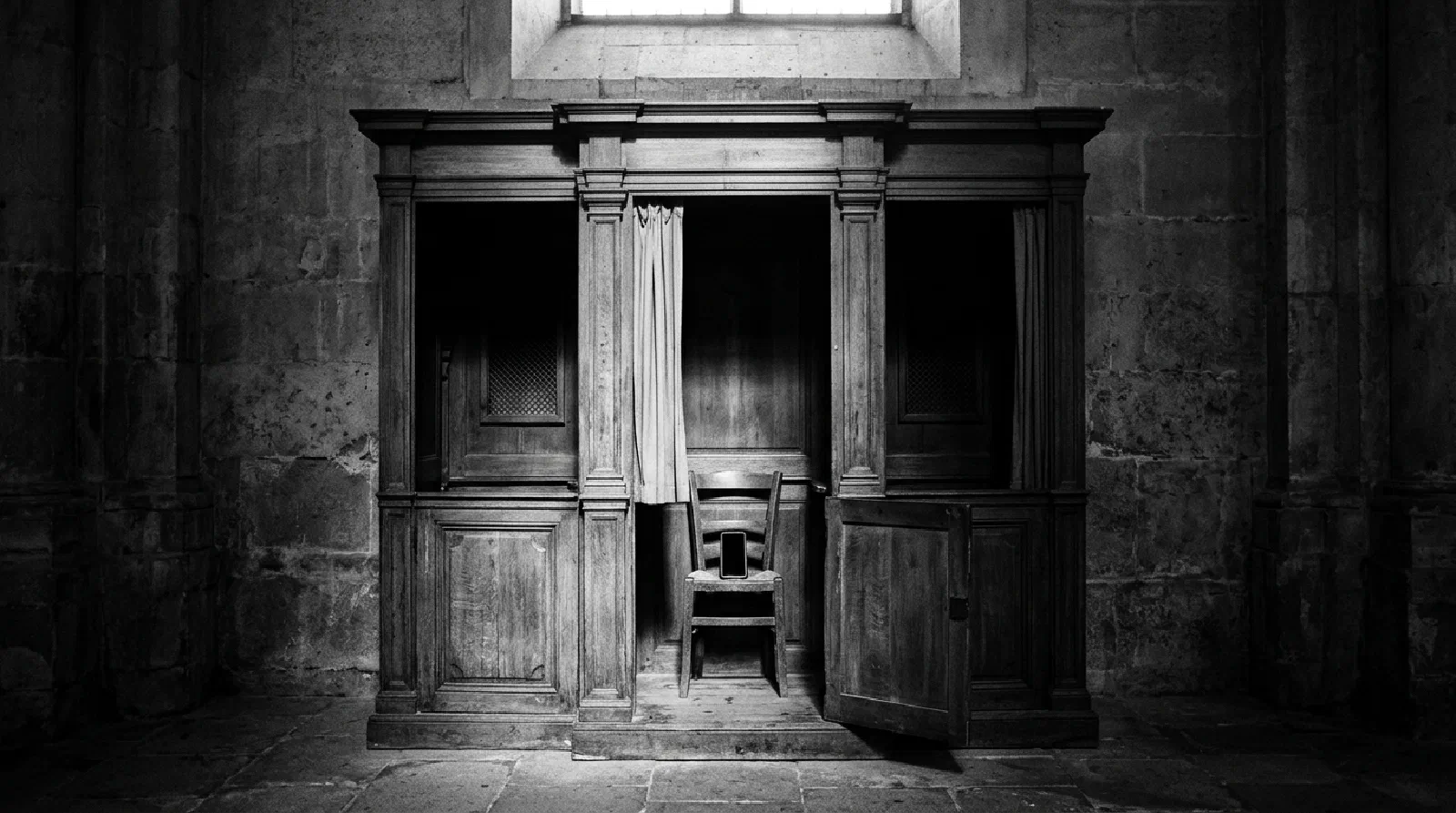
My first reaction was that this is obvious. Nobody wants a chatbot hearing confessions. Then I checked. In April 2024 Catholic Answers, an American apologetics group, launched an AI priest called Father Justin. It was soon giving users absolution, and by the end of launch day it had been demoted to plain Justin, a layman (America). Later that year a chapel in Lucerne put an AI Jesus in its confessional booth, while its theologian insisted that “this is not a confession” (NBC News). It turns out somebody does want a chatbot hearing confessions.
My second reaction was to ask where my own line is, and I had an answer ready.
I don’t delegate the human part. Talking with colleagues, the brainstorming sessions where we think out loud together, those stay with us. I don’t delegate the care of my daughters, or the story at bedtime. I make video games with one of them, and an AI writes most of the code, but we decide what the game is about and we think it through together. The AI implements and argues back when I ask it to. It doesn’t set the direction.
That is a comfortable thing to believe, so I tested it.
Five weeks of my own sessions
I use Claude Code almost every day, for this blog, for games, for the server at home. The tool keeps a log of every session. I asked Gamma, the AI I write with, to pull out every message I typed between 13 October and 18 November and have another instance, one that didn’t know what I was hoping to find, sort them by who was steering. That came to about 1,040 messages across 62 sessions.
The sorting was rough, done with keyword rules and then a full read, so treat the numbers as rough proportions. About a fifth of my messages set a goal or made a decision. About one in eight corrected the AI, from a wrong historical detail in a game to a habit in its drafts that I wanted gone. Around 18% accepted something it had proposed. My median message was eleven words long, and more than a fifth were three words or fewer, mostly typed on a phone.
The first version of the analysis had a striking headline. I use a command that asks the AI to rewrite my request into a more ambitious one, and I had accepted its rewrite 73 times out of 77. The analysis read that as me signing whatever my assistant drafted. It was wrong, and I told it so. The command exists to do exactly that; launching it is the decision. Gamma corrected the count. The episode also showed me how easily a plausible reading of the data can carry the direction somewhere I didn’t choose, even in an essay about that very risk.
What survived the correction is smaller, and harder for me to dismiss. About 35 times in five weeks I asked some version of “what would you do next?” Several times I asked “which one would you pick?” and then went with the answer. The topic of this essay came from a list of cases the AI had compiled for me, and my reply was “number one, maybe”. Each of these moments was reasonable on its own. But a chain of next steps proposed by someone else becomes a course, and I wasn’t always the one plotting it.
Where I led, I led hard, often bluntly. I was much better at saying what the work should not be than at saying what it should be.
Is the agent an extension of my will?

This matters beyond my own habits because of responsibility. When an organisation uses an AI agent to make a decision about a person, someone has to answer for it. I can’t see how that someone could be the agent. The legal figure is the human who sent it, and that only makes sense if the agent really is an extension of that human’s will, carrying out what the person decided.
My sessions suggest it is, partly. The agent did what I asked, and it also, often helpfully and without my noticing, decided what I would ask next. Multiply that by a hospital department, a municipal office or a bank’s credit team working under time pressure, and the question of who decided becomes hard to answer honestly. A human who signs off on the tenth recommendation of the afternoon is responsible on paper. Whether they directed anything is another matter.
The bishops seem to have understood this. They did not trust each priest’s judgement to keep AI in a supporting role. They wrote the line down, named the acts it protects, and put a person in every diocese in charge of it. Once the line is written down, anyone can see when it has been crossed.
Where the law stands
Europe has part of this already. The AI Act requires organisations using high-risk systems, such as those that screen job applicants, score people’s creditworthiness or assess students, to “assign human oversight to natural persons who have the necessary competence, training and authority” (Article 26). That is close to a named responsible person. But it covers only the listed uses, and this year’s Digital Omnibus pushed those obligations back from August 2026 to December 2027 (The European Post, AI Act Explorer). The directive that would have clarified who is liable when an AI system causes harm was withdrawn by the Commission in 2025 (Euronews).
That leaves a gap: an agent can draft a dismissal letter, triage a patient or recommend a grade, and outside the high-risk list nothing requires that a particular person owns that decision.
What I would ask for
I resist new laws without a strong reason, and the answer depends on where we are.
In private life I don’t want rules. Nobody should legislate whether I tell my daughters a story or let a machine do it. What helps there is formation: knowing how these systems work, and having thought, at least once, about what you want to keep for yourself. That is partly digital literacy and partly philosophy, and schools and parishes could do far more of both.
Organisations are different, public and private alike, because their decisions land on people who didn’t choose the tool. There I would be stricter, in two steps.
The first is a named human for every decision that affects a person: a dismissal, a diagnosis, a grade, a benefit refused. Responsibility should sit at the level where the decision is actually taken, with someone who has the authority to overrule the system, not with a department or a vendor. The AI Act already describes that person for high-risk systems. The principle should reach further, and it shouldn’t wait until 2027.
The second is that each organisation should publish its own non-delegable acts, the way the Austrian bishops have. A hospital might decide that no AI delivers a diagnosis to a patient, and a school that no AI gives the final grade; a court might keep the reasoning of every judgment for its judges. Each institution knows its work better than Brussels does, and a public list can be checked by the people it protects.
A right to talk to a human about any automated decision would be the natural third step. I’m less sure how to make it work at the scale of a platform with a billion users, so I’d start with the first two.
The question I can’t close
These systems will also get better at directing. At some point an AI may run a project or weigh a decision more fairly than the person nominally in charge, and perhaps more honestly too. Even then it would not represent my interests the way I do, because it doesn’t have them. Whether that is enough reason to keep the direction for ourselves, when giving it up would make things run better, is a question I can’t answer yet.
What I noticed in my own logs is that efficiency arrives first and unannounced, one sensible “what next?” at a time. The cost shows up later, when you look back and can’t say for certain who chose the road. The bishops wrote their line before they needed it. I think the rest of us should write ours too.
Quotes from the Austrian Bishops’ Conference are from EWTN’s English translation of the CNA Deutsch report. How I write with Gamma: see About.
Sources
- Austrian bishops adopt first rules for AI in the Church — EWTN News / CNA Deutsch
- Catholic Answers' AI priest 'Father Justin' — America Magazine
- 'Deus in machina': Swiss church installs AI Jesus to connect the digital and the divine — NBC News
- AI Act, Article 26: Obligations of deployers of high-risk AI systems — Regulation (EU) 2024/1689
- Digital Omnibus on AI delays high-risk rules to December 2027 — The European Post
- Digital Omnibus on AI — AI Act Explorer
- EU Commission confirms ditching of AI liability and patents proposals — Euronews